Case Studies
Warum Dänemarks Radinfrastrukturbehörde unsere Westküstenfotografie lizenziert hat
Autor:
Björn
VERÖFFENTLICHT
16. März 2026
LESEZEIT
When a specialist at Dansk Kyst- og Naturturisme first reached out in January 2026, she wasn't looking for a photographer. She had already been using one of our images internally for two years.
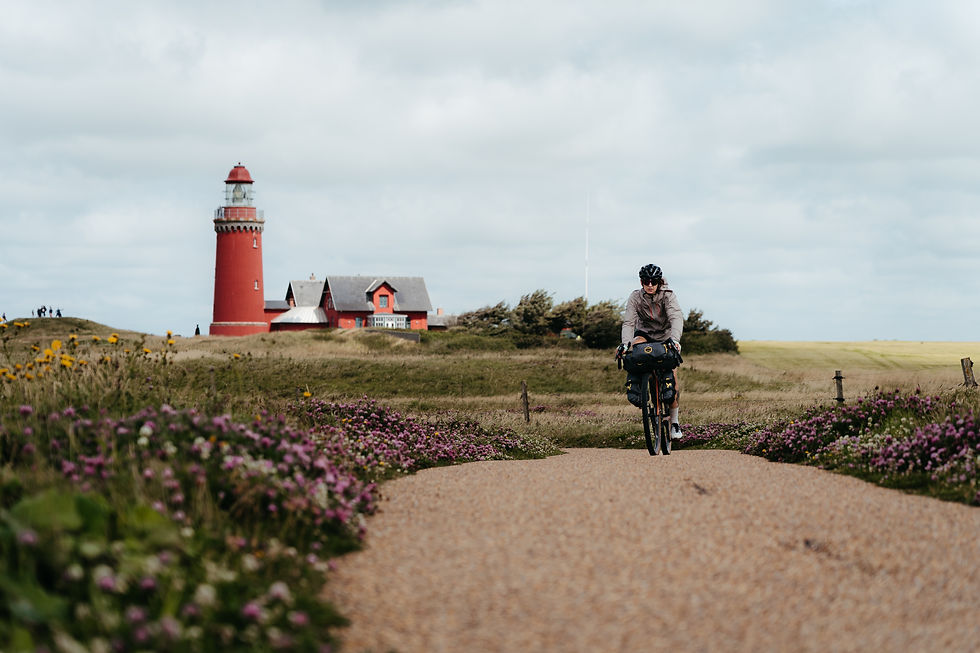
The photo showed Jana riding toward Lyngvig Fyr. She had pulled it from our blog and used it in presentations to a Danish fund, the Danish Nature Conservancy, and her own organisation. Six people in the room. No licence, no agreement, no budget discussion. She just needed a picture that showed what gravel cycling on the Danish west coast actually looks like, and ours was the one she kept coming back to.
That's a useful thing to understand about how photography gets used at the strategic level of destination development. It doesn't always start with a brief. It starts with someone trying to make an argument, and reaching for the image that makes it most clearly.

What Dansk Kyst- og Naturturisme Actually Does
Dansk Kyst- og Naturturisme works behind the scenes — developing strategy and building the backbone for sustainable tourism across coastal Denmark.
Most tourism photography work comes from DMOs or brands with a clear marketing objective. Dansk Kyst- og Naturturisme is something different. They work on the infrastructure level of Danish coastal and nature tourism, outside the four major cities. Their work involves creating cycling infrastructure, developing funding frameworks, and building strategic concepts for the kind of tourism that creates lasting economic value for rural areas, rather than quick seasonal spikes.
The organisation's approach is the opposite of "tourism on steroids." They're not selling destinations to tourists. They're building the conditions that make destinations worth visiting in the first place, and then making the case internally that gravel cycling and bikepacking deserve serious investment.
For that kind of work, the photography problem is specific. You're not trying to inspire a holiday booking. You're trying to convince a colleague, a politician, or a funding committee that a market exists and that it matters. The images need to show reality convincingly enough that people who've never ridden a loaded gravel bike can understand what it feels like, and why it generates economic activity.

What We've Shot on the West Coast
We've ridden the Vestkystruten three times. Hamburg to Skagen in 2022, then back down by train and bad luck. The full loop, Hamburg to Skagen and back, in 2024. We also got engaged near Rubjerg Knude in 2019, which isn't professionally relevant but does explain why the west coast feels like ours in a way that's hard to describe.
What the Vestkystruten gives photographically is something specific. The light there is grey in a way that isn't flat. The weather changes fast enough that you can shoot the same stretch of coastline three hours apart and have two completely different images. The landscape alternates between dune plantations, open heath, beach sections, and working fishing infrastructure in ways that don't feel curated. And the scale is consistently human — a rider and a loaded bike against something much larger, which is the compositional problem that cycling destination photography needs to solve.
Our contact at Dansk Kyst- og Naturturisme said we "capture the spirit of adventure, weather and escapism." The grey, the scale, and the unpredictability of the light are what we keep going back for.
The Images and What They Were For
In February 2026, the team at Dansk Kyst- og Naturturisme selected 12 images from our 2022 and 2024 west coast galleries. The selection included wild camping scenes, cycling infrastructure in the dunes, overnight stays in tents and shelters, Bovbjerg Fyr, the Digevejen path, and what they described as a "cool bikerider." Not a single image was what a traditional tourism brief would specify.
The purpose was equally specific. Dansk Kyst- og Naturturisme needed imagery for professional reports, presentations to funding bodies, and internal strategic materials making the case for better cycling infrastructure investment across coastal Denmark. One image was selected specifically because an infrastructure trailer appeared in the background. That's not a mistake in the brief. That's the brief.
They also noted something that's worth taking seriously: Denmark has very few images of bikepackers spending money. Cyclists in cafes, at food trucks, in accommodation. The economic argument for investing in cycling infrastructure depends on showing that cyclists are high-value visitors, and the photographic evidence for that barely exists in a Danish context. It exists in the Netherlands and Belgium. Not yet in Denmark. We're back there in April.

What This Kind of Work Requires
A brief like this doesn't ask for aspirational imagery. It asks for photography that looks like what cycling on the Danish west coast actually is: variable weather, real infrastructure, loaded bikes, and riders who are clearly there by choice and clearly enjoying it. The gap between that and what stock photography offers is significant enough that a specialist at a national tourism agency spent two years using unlicensed blog images before formalising the relationship.
The photography that makes an argument and the photography that sells a holiday are not the same thing. The brief looks completely different depending on which one you need.
If you're working on destination strategy, infrastructure advocacy, or tourism development in a cycling context, our collaborations page is a starting point.
